FREE SHIPPING ON ORDERS $60 OR ABOVE

PPE PURCHASING TIPS

What to look for when purchasing PPE
Personal Protective Equipment (PPE) are worn for protection against potential disease-causing agents. During this ongoing pandemic, PPE have become a commodity, especially for those working in the frontline. Therefore, it is important to make sure that PPE that is being purchased is safe, functional and of high quality. So, what factors should be considered when it comes to buying PPE in Canada?

Does the manufacturer have authorization to sell PPE in Canada?

PPE that are intended for medical use are called medical devices in Canada and companies that sell PPE must get authorization by Health Canada to distribute them. A Medical Device Establishment Licence (MDEL) is required to sell medical devices, such as PPE, in Canada. Penguin Health has all the necessary licences needed to get authorization by Health Canada to sell their PPE in Canada.

Do the products meet Canadian standards?

Anyone looking to sell medical PPE must ensure that their products meet the standards and certifications approved by Health Canada in order sell them in Canada. Standards are specific for each type of PPE and certify that safe and high quality products are made and sold. Health Canada recognizes the standards for PPE set by various organizations such as the Canadian Standards Association (CSA) and the U.S. Food and Drug Administration (FDA). Some international standards for certain PPE are also acceptable as long as they meet the specifications set by Health Canada, such as the KN95 respirators which are the Chinese standard for respirators. Penguin Health offers products that have been manufactured in Ontario and meet various standards and certifications that have been approved by Health Canada.

What standards should you look for?

Standards specify the design and testing requirements to ensure that safe and functional products are made. Though the standards vary for each type of PPE, there are some requirements that are shared for all types of PPE. For example, the fit of the PPE should offer both safety and comfort to ensure that they not only protect the wearer against potential hazards but also allow the wearer to perform their work without obstruction of movement. PPE should also be durable and sterile with no visible or functional defects. Reusable PPE should have labelling that instructs on the proper decontamination and reuse procedures. The labelling should also include the number of times the product can be reused before it needs to be disposed of. PPE must also undergo various testing procedures to ensure that they can effectively protect against hazards. Penguin Health offers a variety of safe and high quality medical PPE that have been designed and tested to meet all the basic and specific standards that have been approved by Health Canada.

PPE RETAILERS

Who can sell PPE in Canada?

Retailers that want to sell Personal Protective Equipment (PPE) that is to be used in medical settings in Canada have to receive authorization to do so from Health Canada. PPE such as surgical masks, gloves, gowns, N95 respirators and face shields are considered medical devices. Here in Canada, medical devices are classified based on the level of risk that they pose. They can vary from Class I, II, III or IV medical devices, with Class I devices posing minimal risk and Class IV devices posing the highest risk. Most PPE, such as surgical masks, N95 respirators, gowns and face shields, are considered Class I medical devices while gloves are considered Class II medical devices. Companies need to obtain the appropriate licences through Health Canada to manufacture, import and/or distribute medical devices.

What are the different types of licences?

The type of licence that is required for authorization depends on the class of the medical device and whether the company manufactures, imports or distributes the devices. There are two types of licences that can be issued by Health Canada: The Medical Device Licence (MDL) and the Medical Device Establishment Licence (MDEL).

A MDL is a licence that is issued to the individual medical device. Manufactures that wish to import or distribute Class II, III, or IV medical devices are required to get a MDL for each device. In order to obtain this licence, manufacturers must present evidence of their devices’ safety, quality and effectiveness to the Medical Devices Bureau of the Therapeutics Products Directorate. Most PPE do not require a MDL as they are Class I medical devices with the exception of medical gloves, which are Class II devices.

A MDEL is a licence that is issued to any person or company that will be importing and/or distributing the medical devices of all classes for human use in Canada. Manufacturers of Class I medical devices, such as most PPE, are also issued a MDEL in order to import or sell their devices in Canada. A MDEL guarantees that medical devices being imported and sold in Canada meet safety requirements outlined in the Medical Devices Regulations. It also allows Health Canada to keep track of importers and distributors both inside and outside the country that are selling to Canadian facilities, and manufacturers that are either selling their own Class I devices or through a distributor that has an MDEL. As a North America-based manufacturer and distributor of various medical PPE, Penguin Health has all the necessary licences for authorization by Health Canada to manufacture and distribute their products here in Canada.

Due to the rise in demand for PPE as a result of the ongoing pandemic, Health Canada has been fast-tracking authorization for manufacturers to import and sell medical devices of all classes through the Interim Order Authorization. With the Interim Order Authorization, manufacturers and importers can sell medical devices without an MDEL in order to meet the increasing demand.

FACE SHIELD

What is a face shield?

A face shield is a transparent piece of shatterproof plastic that is worn over the face and covers the forehead, eyes, nose, mouth, cheeks and chin. They are held in place by a cap or a strap that wraps around the head. Face shields can be disposable or reusable but reusable face shields are more common because they can be used multiple times after being properly washed and sterilized. They are generally worn in combination with other Personal Protective Equipment (PPE) to ensure effective protection against potentially infectious particulates.

In Canada, face shields used in healthcare are class I medical devices much like other medical PPE. When it comes to face shields, Health Canada recommends the standards set by The American National Standards Institute (ANSI) and the Canadian Standards Association (CSA) for guidance in design and testing. Manufacturers must take into account a number of specifications including ensuring a snug fit of the head strap while preventing slippage and using materials that make the shield optically clear and anti-fog. Penguin Health offers reusable face shields manufactured in Canada that are breathable, anti-fog and anti-dust, and meet the standards and certifications for distribution in both the U.S. and Canada.

Why should you use a face shield with your PPE?

When worn by healthcare workers as part of their PPE in combination with face masks and isolation gowns, face shields offer added protection to the wearer against the spray and splatter of bodily fluids that can potentially carry harmful agents. They offer more extensive coverage of the face than do face masks and goggles, protecting more areas of the face from contaminants, including the eyes. This added protection is essential for healthcare workers during this pandemic as they are unable to socially distance from their patients and are constantly at risk of being exposed to the virus and other infectious diseases. Face shields can also enhance the protection of patients from exposure to potentially harmful respiratory droplets from the wearer. They can even potentially extend the useful life of face masks that are worn with them by blocking a significant amount fluid particulates before they reach the mask. In general, face shields have their limits when used on their own but when combined with other PPE they can significantly improve protection against infectious diseases.

What is the difference between a Halyard N95 respirator and a KN95 respirator?

What is the difference between a Halyard N95 respirator and a KN95 respirator?

The purpose of a filtering facepiece respirator is to form a tight seal around the nose
and mouth, and protect the respiratory system by filtering out potentially harmful
particles. Respirators are an important piece of Personal Protective Equipment (PPE)
for frontline workers that are more likely to come into contact with these potentially
harmful particles. Therefore, when it comes to choosing the best filtering facepiece
respirator for the job, they must carefully look at the similarities and differences between
the variety of available respirators. Penguin Health offers the Halyard Health
manufactured N95 respirator and KN95 respirator, both of which meet standards
recognized by Health Canada. So, what are the major similarities and differences
between these two types of respirators?

The Halyard N95 respirator is manufactured according to the standards of the U.S.
National Institute of Occupational Safety and Health (NIOSH). NIOSH certified N95
respirators are recognized by Health Canada as the standard for high quality N95
respirators for use in the medical field. They are tested and evaluated on their fit, filter
efficiency and breathability. They protect the wearer’s respiratory system by filtering out
95% of potentially harmful particulates and viruses. Much like other NIOSH certified N95
respirators, the Halyard N95 respirators form an effective fit around the nose and mouth
and are fluid resistant. They typically have a duckbill shape for increased breathability
and straps that go around the head to hold it in place.

The KN95 respirator is the Chinese standard for filtering facepiece respirators. They
have received approval by Health Canada as an alternative for NIOSH certified N95
respirators as long as they have been tested to meet the appropriate standards. Like
the N95 respirators, they filter 95% of particulates from the air. They typically have a
cup design with earloops to hold them in place and have similar testing done on them
as the N95 respirators, including fit testing, filter efficiency and breathability.
The main difference between them is that the Halyard N95 respirators and the U.S.
standard while the KN95 respirators are the Chinese standard. In terms of design,
function and performance, Halyard N95 respirators and KN95 respirators are very
similar. They can both filter 95% of small particulates in the air and they both meet
standards that are recognized by Health Canada. Halyard N95 respirators are slightly
more breathable than the KN95 masks but the KN95s are slightly cheaper in price.

Though N95 respirators are the preferred choice by most, the KN95 respirators have
been shown to be suitable alternatives by Health Canada

How do you wash a reusable isolation gown properly?

How do you wash a reusable isolation gown properly?

The benefit of using a reusable isolation gown over a disposable one is that a reusable
gown can be used multiple times before needing to be replaced. It is important to know
the proper way to wash and sterilize reusable gowns to ensure that they continue to
provide effective protection against infectious diseases after every wash cycle.
Manufacturers often provide information on the proper washing techniques for their
products. Penguin Health is one such manufacturer that makes its AAMI-rated reusable
gowns in Ontario and provides detailed instructions for proper laundering procedures.

There are many factors to take into account when it comes to washing a reusable
isolation gown. Firstly, the gowns should be checked for any sharp objects that could
cause damage to the fabric before washing. Temperature is another factor that should
be taken into consideration at all steps of the washing process. Level 3 AAMI gowns for
example usually cannot handle temperatures exceeding 82C and so they cannot be
ironed and must be washed and dried at lower temperatures. Gowns should also not be
exposed to high pressures or strong chemical detergents. In general, the gowns should
we washed in mild detergent under low or medium pressure and dried at a reasonably
low temperature to ensure that they are not damaged. After drying, gowns should be
cooled for an adequate amount of time and the promptly folded to prevent wrinkling.
The quality of the gowns should be checked regularly to ensure that their performance
is still reliable.

Why is it important to properly wash isolation gowns?

The purpose of an isolation gown is to protect the wearer’s body against potential
disease-carrying droplets and particulates. Healthcare workers are especially at risk of
being exposed to fluids and particulates that can cause infectious diseases. If a
reusable isolation gown isn’t washed correctly, it increases the risk of exposing the
wearer to those infectious diseases. Whether the gown isn’t fully sterilized during the
process or it is damaged at any point during the process, the effectiveness and the
useful life of the gown will decrease and it will have to be replaced much faster than if it
had been washed properly.

How many times can a reusable isolation gown be washed?

The number of times reusable gowns can be washed usually depends on the material of
the gown. If a gown is made of a more durable material it is likely to survive more wash
cycles without significantly compromising efficacy and quality. Modern AAMI-rated
reusable isolation gowns can be washed more than 100 times. The information on the
number of wash cycles that a gown can undergo should be given by the manufacturer.
Penguin Health offers two types of level 3 AAMI rated reusable isolation gowns: one
that can survive 100 wash cycles and one that can survive more than 150 wash cycles.

What is the proper way of putting on and taking off PPE?

What is the proper way of putting on and taking off PPE?

The purpose of Personal Protective Equipment (PPE) is to protect wearers from
potentially hazardous particulates that can carry infectious diseases. Learning the
proper way to don and doff PPE ensures that effective protection is provided at all
times. In the medical field, healthcare workers are often trained in the proper techniques
for putting on and taking off PPE safely. The order and detail of each specific step
ensure the safety of both the wearer and their equipment.

Before PPE can be donned, hands have be washed and sanitized properly using hand
soap or an alcohol based hand sanitizer. Next, the isolation gown is donned and the
straps behind the neck and waist are tied. The gown should fit securely and
comfortably, covering the arms and body from the neck all the way down to the thighs.
The next item to be worn is the mask. Masks are secured by ties or elastic bands at the
back of the head and an elastic metal band secures the mask in place on the nose
bridge. When worn properly, the mask should cover the nose, mouth and chin. Surgical
masks have a loose fit while with respirators it is important to ensure that a seal has
formed around the nose and mouth. Goggles and face shields are to be donned next for
eye protection. Adjustments can be made to ensure that the fit is snug and vision is
clear. Finally, the last items to be donned are the gloves. Gloves should be worn
carefully to prevent tears and should be long enough so that the cuffs of the gloves
cover the cuffs of the gown below the wrist ensuring that no skin is being exposed.
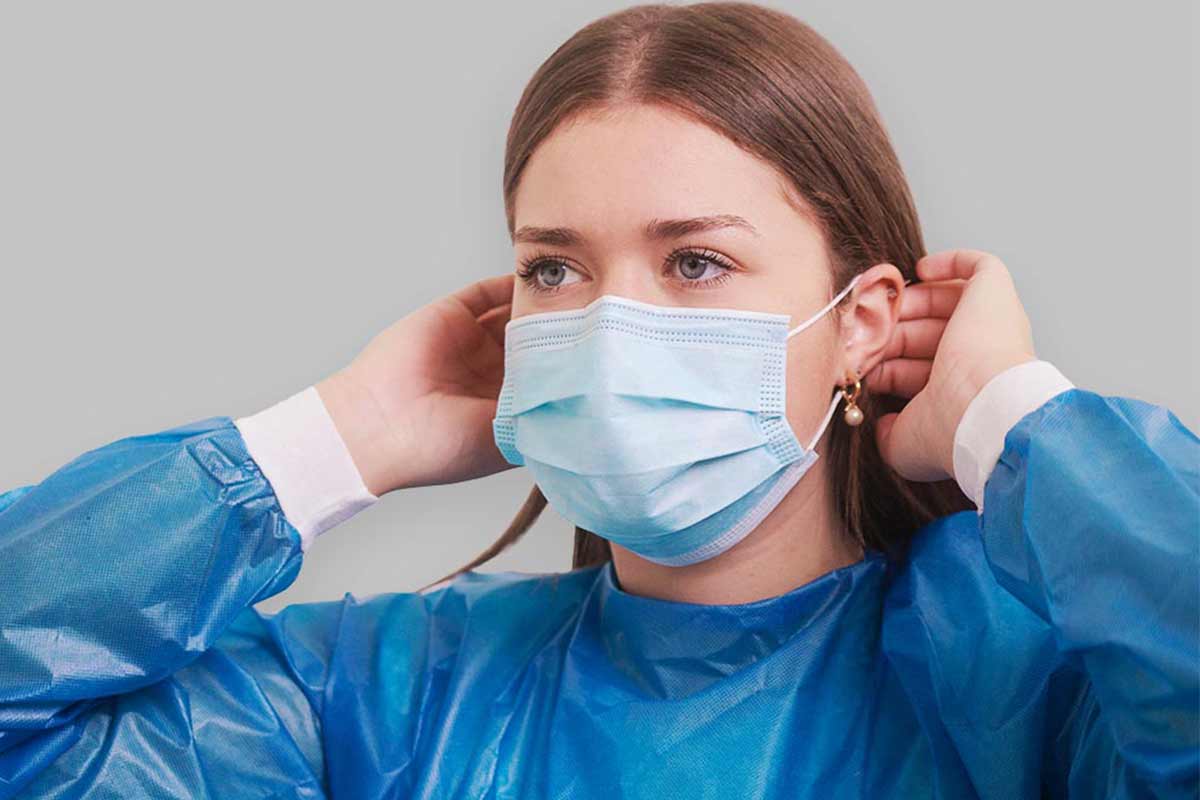
Once PPE is donned, it is important to avoid touching or adjusting the equipment to
prevent unnecessary contamination.

Just as with donning, doffing involves specific steps that prevent contaminants from
reaching the wearer. The first items to be removed are the gloves. With one gloved
hand the other glove is peeled off from the edge close to the wrist until it is completely
inside out. The removed gloved in held in the remaining gloved hand and then the
remaining glove is removed by sliding a finger of the un-gloved underneath the glove
and peeling it off until it fully covers the first glove. The gown is removed next by first
unfastening the neck and waist ties and then rolling off the gown starting from the back
of the shoulders, ensuring that only the inner surface of the gown is touched. The
goggles and face shields are the next items to be removed. They are lifted up from the
back using the headbands or earpieces that secured them in place. Masks are removed
last by untying the ties or elastic bands the fastened the mask in place and using them
to pull the mask away from the face. All disposable items should be properly thrown
away and reusable items should be taken to their designated containers. Hand washing
is an important last step but hands should also be washed or sanitized after each step
to further prevent contamination, especially since the outer parts of these items are
contaminated.

What is Level 3 ASTM? What are the differences between a level 2 & 3 ASTM surgical mask?

What is the difference between a level 2 and 3 ASTM surgical mask?

Surgical masks are used regularly by frontline workers as part of their Personal
Protective Equipment (PPE) as they offer protection of the nose and mouth from
potentially infectious respiratory droplets and fluid particles. ASTM-rated Level 2 and 3
surgical masks are often the preferred choice in medical settings because ASTM rated
masks are known for their safety and high quality. They are made according to the
standards set by the American Society for Testing and Materials (ASTM) and are
approved by both the U.S. Food and Drug Administration (FDA) and Health Canada.
ASTM levels are assigned based on the results of tests done on the barrier of the mask.
So, what is the difference between level 2 and level 3 ASTM surgical masks?

The barrier of ASTM-rated masks is tested for fluid resistance, breathability, bacterial
and particle filtration efficiency and flammability. Level 2 surgical masks offer moderate
barrier protection and are more suited to be used in situations and procedures where
there is a low to moderate risk of exposure to fluid splatter and aerosols. Compared to
level 1 masks, they are significantly more fluid resistant and have better filtration
efficiency. They are typically used in moderate-risk non-surgical procedures.

ASTM level 3 surgical masks provide the most barrier protection of all ASTM-rated
masks. They have the highest fluid resistance and bacterial filtration efficiency but as a
result they also have the lowest breathability. These qualities make it the most useful for
procedures where the risk of exposure to fluid spray and aerosols is the highest. They
are the best to use during most surgical procedures with the exception of those that risk
exposure to vapours and airborne pathogens, for which a respirator will be needed.

Despite the fact that they are rated differently, there are very few differences between
level 2 and level 3 ASTM surgical masks. Level 3 masks are more fluid resistant and
less breathable but in terms of bacterial and particulate filtration they both perform at a
similar level. Also, both masks provide adequate protection against respiratory droplets
which can carry viruses, such as the virus behind the ongoing pandemic. However,
because of its ability to better resist fluid spray the level 3 mask is the preferred choice
for moderate to high risk procedures. Penguin Health offers both level 2 and level 3
ASTM surgical masks that have been manufactured in Ontario and meet the standards
of Health Canada.

DIFFERENCES IN REUSABLE ISOLATION GOWNS

What is the difference between level 3 and 2 AAMI reusable isolation gowns?

Isolation gowns are a very crucial part of the Personal Protective Equipment (PPE) of
frontline workers, especially those in the medical field. They protect most of the body
against the splatter of fluids and particulates. Picking the right gown for the right
situation is crucial for healthcare workers as they are constantly exposed to these fluids
and particles that can carry infectious diseases. Level 2 and 3 reusable AAMI isolation
gowns that have been manufactures according to the guidelines of the American
National Standards Institute/Association of Advancement of Medical Instrumentation
(ANSI/AAMI) are recognized by both the U.S. Food and Drug Administration (FDA) and
Health Canada for their high performance and quality. Gowns that meet the standards
set by AAMI are rated Level 1, 2, 3 or 4 depending on the amount of protection they
provide. So what exactly is the difference between level 2 and 3 reusable AAMI isolation
gowns?

AAMI Level 2 reusable isolation gowns provide some resistance to the spray and
splatter of fluids. Following AAMI standards, they are tested on their ability to resist the
impact of water and their resistance against pressurized water. They can block fluids
significantly better than level 1 gowns and are used by healthcare workers in situations
where risk of exposure to fluids splatter is low, like when drawing blood or working in a
pathology lab. They are typically not suitable for use in sterile environments.
AAMI level 3 reusable isolation gowns provide moderate resistance to fluid splatter and
spray. The tests done on level 3 gowns are similar to those done on level 2 gowns and
the results show that level 3 gowns provide higher resistance against water impact and
pressurized water than level 2 isolation gown. Therefore they are more suitable in situations
where exposure to fluids is higher, like when drawing arterial blood, doing IV insertions
and working in trauma. They can be used in sterile environments, though level 4 gowns
are the more likely to be used.

Overall, the main differences between the level 2 isolation gown and 3 AAMI rated reusable isolation
gowns stem from their ability to resist fluids and protect against fluid-borne pathogens.
For situations in which the risk of contamination is low level 2 gowns are acceptable but
for situations where the risk is high level 3 gowns are preferred. Penguin Health offers
both level 2 and level 3 AAMI rated washable isolation gowns that have been
manufactures in Ontario and meet Heath Canada standards. As they are both reusable,
the materials used to manufacture these gowns are similar with small differences to
account for their difference in barrier protection levels. Both gowns have also been
shown to offer effective protection against respiratory droplets that can viruses, making
them essential during this pandemic. In general, the best way for healthcare workers to
decide which gown to choose is to asses the risk of exposure in each situation they
encounter and make an informed decision based on this information.

What is Personal Protective Equipment PPE?

What is PPE?

Since the beginning of this pandemic, the letters PPE have become part of our daily lexicon. It has been established that PPE is a valuable commodity today, but not everyone knows why. PPE is an acronym for Personal Protective Equipment. There are many different types of PPE depending on the purpose that the PPE is supposed to serve for the individual wearing it. In this post, we will be focusing on PPE for medical purposes. PPE in medical settings essentially creates a barrier between the person wearing the PPE and potential environmental hazards that increase the risk of exposure to infectious disease. PPE includes gloves, gowns, surgical masks, face shields, goggles, respirators, and many other items. PPE that is used for medical purposes are called medical devices and need to be approved by Health Canada to be sold and distributed. Companies providing medical PPE to the public such as Penguin Health have had their products tested and meet Health Canada and FDa standards to ensure the quality and standards of the product.

Why is PPE important?

PPE keeps healthcare workers on our frontlines safe and reduces the spread of virus and bacteria. Many frontline healthcare workers are unable to keep a safe distance from patients when working with them. PPE allows these workers to maintain their own and their patients’ safety, without compromising on the care that is being provided. The PPE creates a barrier between an individual’s mouth, nose, eyes, skin, and a virus or bacteria. The barrier prevents any contaminants in blood, respiratory secretions and other body fluids from coming into contact with individuals, therefore protecting both the person wearing PPE and others around them, especially those who have a higher risk of contracting infections.

How effective is PPE in protecting health care workers from viruses and bacteria?

In medical settings,  spread through aerosol droplets or contaminated surfaces. Therefore, PPE that create a strong liquid barrier are needed to protect individuals in these settings. Different medical procedures also require different levels of PPE protection. For instance aerosol generating procedures may contaminate the air with droplets containing the virus, making it crucial that a stronger, higher-level fluid-resistant PPE is being used in that environment. Penguin Health has been locally manufacturing reusable medical isolation gowns of superior quality in Ontario, CA, that have been tested to meet standards for optimal protection from contaminants.

The effectiveness of PPE is dependant on the medical procedure and the level of protection standard provided by the PPE. PPE that create a liquid barrier are effective in protecting healthcare workers during procedures where they may come in to contact with contaminated aerosol droplets, or other bodily fluids. Certain PPE such as N95 respirators provide more effective protection from exposure to smaller contaminated aerosol droplets than surgical masks. It is important to be aware of the different levels of protection provided by various PPE. Penguin health. manufactures and retails various medical PPE of different levels of protection that are Health Canada and FDA standards. To order your Level 3 ASTM masks and Isolation gowns call or order online from Penguin health. www.penguinhealth.co

Reusable AAMI Level 3 Gowns

What Are AAMI Level 3 Reusable Isolation Gowns?

In order to get the best protection from exposure to potentially harmful agents, healthcare workers must ensure that the isolation gowns they choose as part of their Personal Protective Equipment (PPE) is effective and of high quality.

Reusable AAMI level 3 gowns are one of many types of reusable isolation gowns that have received the certification of a level 3 AAMI gown according to the standards set by AAMI. AAMI stands for the Association of the Advancement of Medical Instrumentation, an organization that produces international technical standards for a variety of medical devices, including isolation gowns.

Their standards are recognized by Health Canada for producing safe and high quality medical devices. According to the standards set by AAMI, isolation gowns can be categorized into 4 different barrier protection levels depending on the intended function of the gown.

At each increasing level, healthcare workers face situations and procedures that put them at more risk than at the level below. Therefore, at each level, the performance of the gown’s fluid barrier at its critical zones must be tested for its ability to resist potential fluid-borne hazards.

The critical zones are the areas of the gown are most likely to be exposed to fluids. Level 3 gowns are utilized by healthcare workers in moderate risk situations and are tested for their ability to resist impact by water and water pressure.

Compared to level 2 gowns, level 3 gowns provide better protection against a larger volume of splatter and fluid pressure. Level 1 gowns are used for minimal risk situations while level 4 gowns are used in situations where risk to viral infections are highest.

Level 3 gowns are used by healthcare workers that draw arterial blood, insert IVs, and work primarily in the emergency room, trauma, the burn unit and in the critical care unit.

Why Use AAMI Level 3 Reusable Isolation Gowns?

There are many factors that make reusable AAMI level 3 gowns beneficial to healthcare workers. Firstly, the standards set by AAMI for medical devices are recognized worldwide for the production of safe and high quality products.

Also, level 3 AAMI gowns offer better protection for a larger variety of medical procedures and situations than gowns that have a lower level rating. Finally, Penguin health AAMI level 3 gowns are reusable, which means they can be washed and sterilized for reuse multiple times before needing to be replaced.

Depending on the specifications given by manufacturers, reusable gowns can survive multiple wash cycles without compromise to safety and effectiveness.

Many healthcare facilities that are facing shortages as a result of the pandemic are opting to use reusable gowns to meet their needs because of their sustainability and cost-effectiveness.

Reusable gowns are more environmentally friendly and save on costs as they create less waste and require less resources than disposable gowns.

Penguin Health offers reusable AAMI level 3 gowns that meet Health Canada and FDA standards for all AAMI standards, and are sourced and manufactured in Ontario, Canada.